The Cryptographic Time Machine: Why Precise Authentication Tracking Matters for Enterprise Security
Ask any cybersecurity forensics expert about their biggest nightmare during a post-incident investigation, and they will give you a single answer: vague timestamp windows.
When a security breach occurs or a critical piece of intellectual property is exfiltrated, time is the ultimate variable. Security teams don't just need to know *what* happened; they need to reconstruct an airtight, second-by-second timeline. They need to prove exactly which flesh-and-blood human operator was sitting in front of a specific physical console at precisely 2:14:05 PM.
Unfortunately, traditional Identity and Access Management (IAM) tools leave massive blind spots in log histories. Because legacy solutions check identity at a single point in time, administrators are left guessing who was actually controlling a terminal during a critical event window.
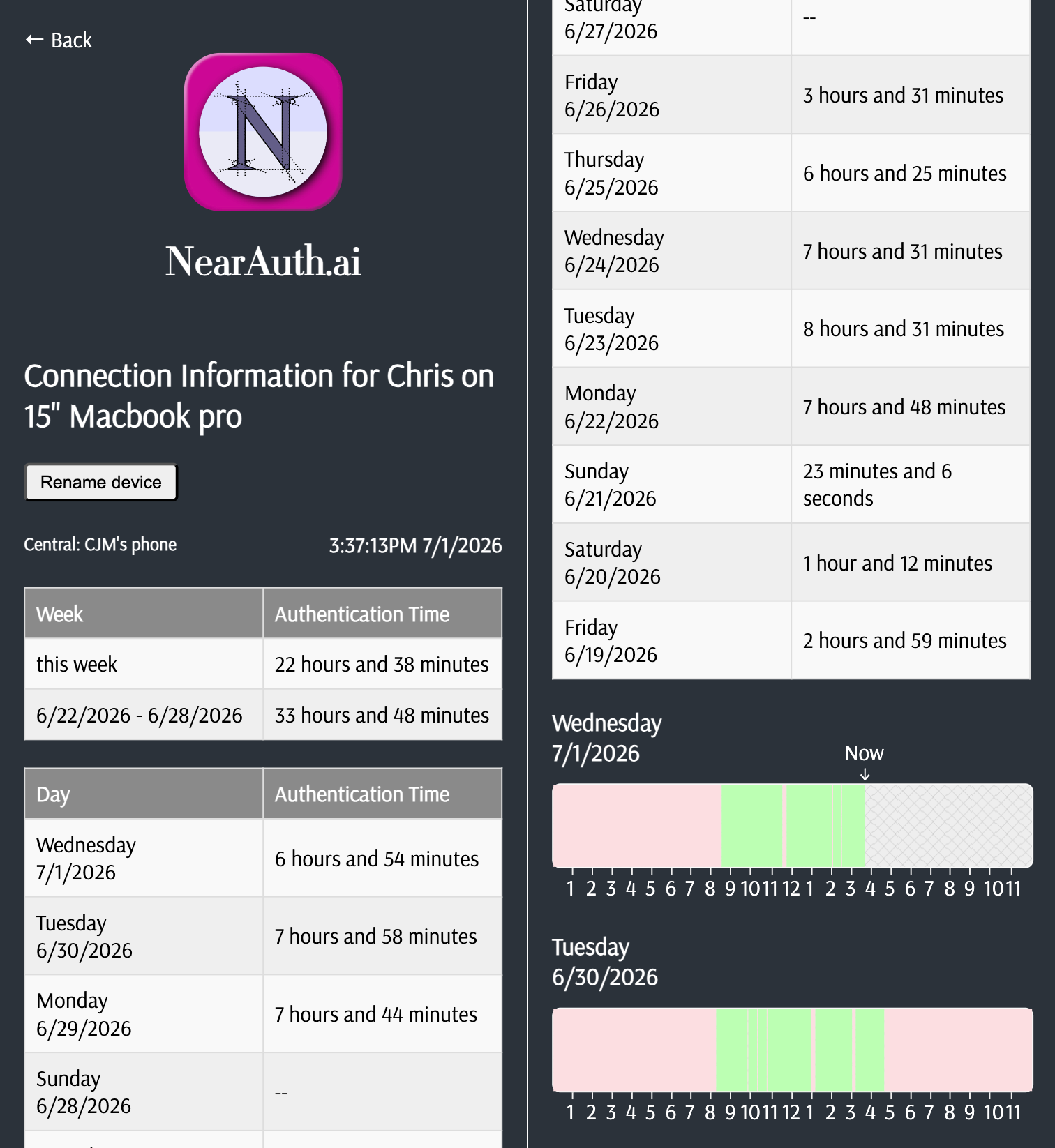
At NearAuth.ai, we have architected an identity engine that bridges this gap natively. By tracking continuous cryptographic presence, NearAuth.ai provides security administrators with an immutable, real-time audit log showing exactly who was authenticated, where, and at what precise millisecond.
Why Absolute Temporal Visibility is Critical
Knowing the exact correlation between a human identity and a specific timestamp window isn’t just a nice feature—it is the foundation of modern enterprise governance. Here is why this continuous auditable ledger changes the game for security administrators:
1. Rapid Incident Response & Blast Radius Isolation
When an anomaly is detected—such as an unauthorized database export or an unscheduled system configuration change—the incident response clock starts ticking. Without precise temporal data, security teams must broaden their investigative blast radius, auditing hours of network traffic and interviewing dozens of team members.
NearAuth.ai allows administrators to cross-reference the exact millisecond of the malicious query against continuous physical proximity logs. Security teams can immediately isolate the exact terminal, prove who was physically present, and determine if an employee’s identity was compromised or hijacked remotely.
2. Unassailable Non-Repudiation
In high-compliance environments—like financial trading floors, medical centers, and defense operations—proving "non-repudiation" is mandatory. Non-repudiation means a user cannot deny having performed an action because the system provides undeniable proof of their execution.
Because NearAuth.ai relies on local, hardware-bound asymmetric keys that sign continuous challenge packets, the logs don't just state that a user "was logged in." They cryptographically prove that the user’s designated proximity device was physically present at that explicit time window, creating a legally defensible chain of custody.
3. Mitigating the Insider Threat and "Session Hijacking"
The most dangerous insider threats don't always involve malicious employees; they often involve opportunistic ones. If an engineer leaves a workstation unlocked to grab a coffee, a bad actor can pass by, execute a quick command, and walk away in under thirty seconds.
Standard SIEM tools will log that command under the innocent engineer’s account. NearAuth.ai’s continuous proximity logging reveals the exact moment the authorized token moved out of range, mapping any commands executed during that gap as anomalous or unauthorized. Administrators see the precise second of departure and arrival, instantly exposing unauthorized session handovers.
Log Resolution Head-to-Head: Standard IAM vs. NearAuth.ai
| Audit Vector | Standard IAM logs (Point-in-Time) | NearAuth.ai Cryptographic Audit Logs |
|---|---|---|
| Timestamp Precision | Logs the initial login moment only (e.g., "User logged in at 08:30 AM"). | Continuous temporal tracking (e.g., "User present from 08:30:02 to 11:14:55"). |
| Session Hijacking Visibility | Blind. Cannot detect if a different person uses an already unlocked screen. | Total. Logs the exact moment a verified identity token leaves the proximity perimeter. |
| Cryptographic Proof | Centralized database entry showing a text-based "success" log. | Immutable ledger of hardware-signed asymmetric key challenges per timestamp window. |
Continuous Auditing for a Zero-Trust World
Compliance frameworks like SOC 2, ISO 27001, HIPAA, and FedRAMP are shifting rapidly away from point-in-time checks. Modern compliance demands continuous verification. If your identity infrastructure only knows who logged in at the start of a shift, your compliance framework is built on a foundation of assumptions.
NearAuth.ai provides the definitive data layer that corporate compliance officers and security administrators need. By treating identity as a continuous, time-bound stream rather than a static binary switch, we ensure that your audit logs always represent the ground-truth reality of your workspace security.
chris@nearauth.ai