Death by a Thousand Prompts: How MFA Fatigue is Killing Employee Productivity (and Security)
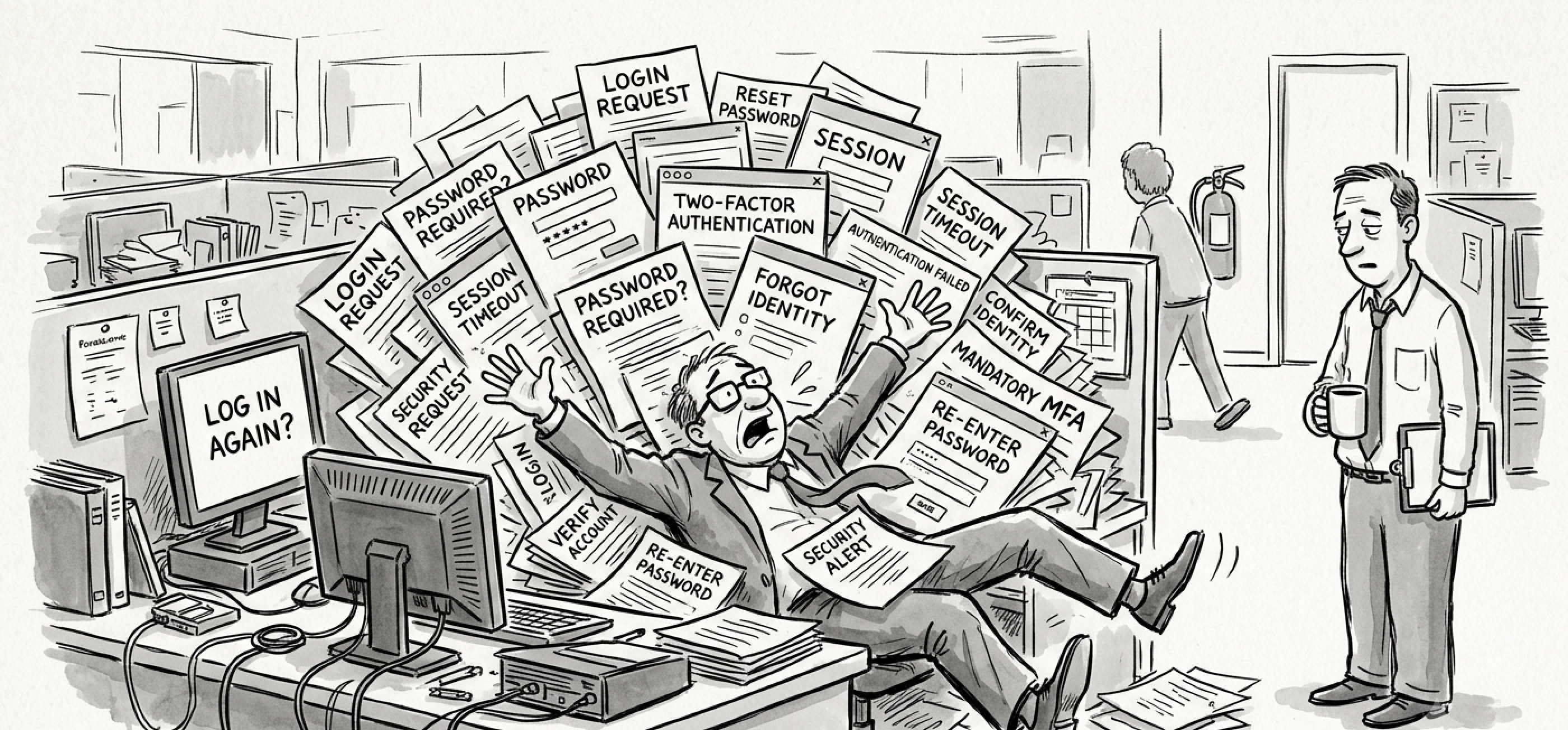
Picture the start of a standard workday for an enterprise employee. They sit down, wake up their laptop, and attempt to log into their email. Buzz. A push notification hits their phone. They authenticate. They open the internal wiki to review a project specification. Buzz. Another authentication prompt. They click an AWS Console link, open corporate payroll, or jump into a customer CRM. Buzz. Buzz. Buzz.
By 10:00 AM, the average knowledge worker has shifted context a dozen times—not because of their actual tasks, but simply because they are proving their identity to their own tools. This is the reality of MFA Fatigue. What started as an essential defense-in-depth security practice has mutated into a severe silent tax on employee productivity and mental bandwidth.
At NearAuth.ai, we believe enterprises shouldn't have to choose between keeping threat actors out and letting their workforce move at full speed. Here is how legacy Multi-Factor Authentication (MFA) is failing your team, and how modern ambient identity can fix it.
The Cognitive Cost of Friction
Every time an employee is forced to pick up their phone, scan their thumb, or type a 6-digit SMS code, a microscopic context switch occurs. Psychology tells us that human attention doesn't change channels cleanly. When a push alert interrupts a software engineer mid-code or a financial analyst mid-spreadsheet, a phenomenon called "attention residue" sticks behind.
When multiplied across thousands of employees logging into hundreds of SaaS tools daily, legacy MFA transforms from an infrastructure layer into a multi-million dollar bottleneck. Employees begin dreading security protocols, treating compliance as an obstruction rather than a shared corporate value.
The Security Paradox: When Fatigue Breeds Vulnerability
The irony of high-friction security is that it ultimately leads to catastrophic security failures. When people are exhausted by constant verification requests, they stop evaluating them. They switch to autopilot.
This psychological exploit has given rise to one of the most effective modern hacking techniques: MFA Prompt Bombing.
- The Attack vector: A threat actor harvests a user's corporate password. They then trigger dozens of push notifications to the user’s mobile app at 3:00 AM or in rapid succession during a busy afternoon.
- The Collapse: Desperate to make the annoying buzzing stop so they can return to sleep or finish their work, the fatigued employee eventually taps "Approve."
This precise vulnerability led to major corporate breaches at tech giants worldwide. Legacy identity providers like Okta or Auth0 have tried to patch this by adding more complexity—forcing users to match numbers or complete captchas. But adding more friction to fix a friction problem is a losing game. It only deepens the productivity crisis.
The Zero-Trust Realignment: True security shouldn't rely on a human being's infinite patience with push notifications. It should rely on continuous, unforgeable, ambient validation.
How NearAuth.ai Cures MFA Fatigue Without Lowering the Shield
NearAuth.ai fundamentally transforms the authentication philosophy. Instead of aggressively interrupting users with point-in-time "challenges," NearAuth.ai establishes a paradigm of Ambient, Continuous Identity Validation.
1. Proximity-Based Seamless Authentication
NearAuth.ai utilizes secure cryptographic proximity signals between an employee's authorized secondary device (like a smartphone or smartwatch) and their active workstation. If your phone is physically sitting next to your laptop, NearAuth.ai cryptographically registers your presence. Logging into an internal database or changing an app directory happens immediately and seamlessly in the background—no manual approvals or code-typing required.
2. Hardware-Bound Asymmetric Verification
Behind every seamless login is uncompromised zero-trust security. NearAuth.ai replaces insecure mobile push notification relays with hardware-bound asymmetric keys. The proximity check verifies that your physical token is present and signs an isolated payload locally. Since nothing travels over the open network to trigger global notifications, "Prompt Bombing" is architecturally impossible.
3. Continuous Contextual Attestation
Instead of validating a session once every 8 hours and assuming everything is fine, NearAuth.ai continuously checks security posture invisibly. It maps device health, enterprise network paths, and behavioral signals silently. If the environmental context remains trusted, the employee works completely unhindered. If a risk anomaly is detected—such as a sudden network change—NearAuth.ai gracefully asks for confirmation without disturbing the flow state prior.
Friction vs. Flow: A New Enterprise Identity Matrix
| Workforce Dimension | Legacy Multi-Factor (Okta / SMS / Push) | NearAuth.ai Ambient Security |
|---|---|---|
| User Action Required | Pick up device, open app, tap/type numbers. | Zero. Identity is verified via secure ambient proximity. |
| Impact on Focus State | High. Fractures deep focus with active interruptions. | None. Keeps workers inside their execution flow. |
| Prompt Bombing Risk | Vulnerable. Users can be badgered into malicious approval. | Eliminated. No external, out-of-band pushes can be triggered. |
| Session Trust Validation | Static. Point-in-time check at initialization. | Dynamic. Continuous assessment of device environment. |
Reclaim Your Workforce Flow State
Enterprise security shouldn't feel like an adversarial relationship between your IT department and your employees. When security is friction-free, compliance reaches 100%. By replacing intrusive, legacy push-based systems with cryptographic proximity authentication, NearAuth.ai eradicates MFA fatigue, closes the prompt-bombing vulnerability, and hands your team back hours of daily deep-focus productivity.
It’s time to stop prompting your employees to death. Move to the era of ambient security.
chris@nearauth.ai