Why Your Security System Should Act More Like Your Neighbor Dave
Imagine walking out to your driveway on a Tuesday morning. You see your neighbor standing by his lawnmower.
"Morning, Bob!" you say.
Bob doesn't reply. Instead, Bob pulls out his phone, dials a toll-free hotline, and waits for a server
farm in Boardman, Oregon to confirm that the person standing five feet away from him is indeed you. Three
minutes later, after cross-referencing your IP address, sending a six-digit SMS code to your phone, and
evaluating your gait, the server pings Bob’s screen: IDENTITY VERIFIED.
Bob looks up. "Morning, Tim."
Sounds ridiculous, right? Of course it does. You know who's good at recognizing somebody in front of them? People are—because they're right in front of them.
So why on earth are we still letting our digital workstations rely on a distant datacenter thousands of miles away to answer a question that should be solved right here on your desk?
The Great Distant Datacenter Guessing Game
Let’s look at traditional corporate security for a second.
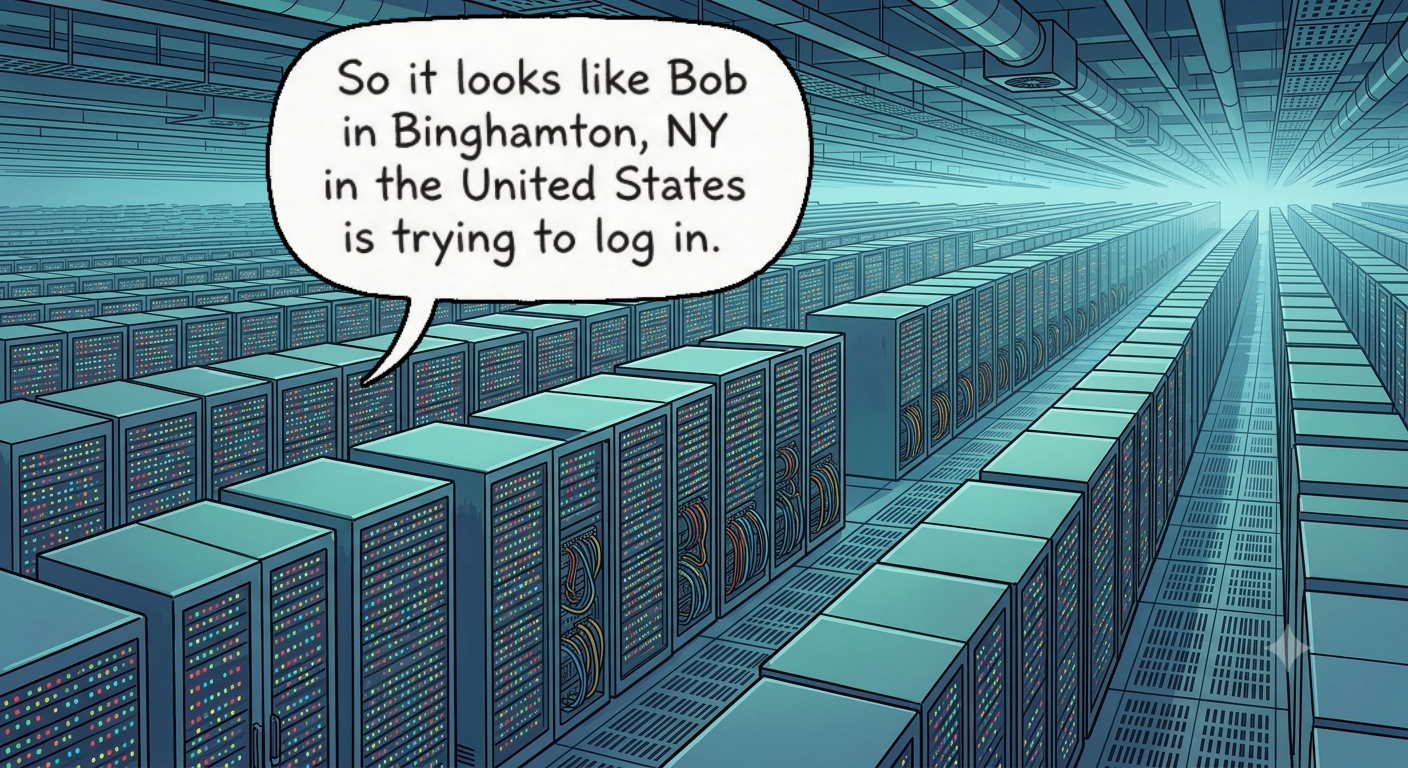
Right now, enterprise authentication operates like a hyper-paranoid remote pen pal. Every time you open your laptop, log into Slack, or access a cloud database, your computer reaches out across miles of fiber-optic cable to a sprawling server farm in Boardman, Oregon (or Quincy, Washington, or Dublin).
That server sits in a chilled room surrounded by thousands of humming server racks, trying its absolute best to figure out if you are actually you.
Server in Oregon:
"Well, the request came from an IP address in Ohio... but the user clicked the button 2 milliseconds faster than usual... and wait, is that a browser update? QUICK! Ping their phone! Send an SMS! Make them select all images with traffic lights! Push notification fatigue be damned!"
It’s an exhausting game of digital telephone. Traditional multi-factor authentication (MFA) treats security like an ongoing interrogation because remote servers lack physical context. They can’t see you. They don't know you're sitting in your office chair holding a fresh mug of coffee. They only know what the network packet tells them.
And that disconnect creates two major headaches:
- Endless Friction: Constantly grabbing your phone to tap "Approve" every 20 minutes.
- Real Security Gaps: Hackers exploiting MFA bombing, phishing prompts, or stolen session tokens because remote credentials can be tricked from anywhere on Earth.
Bringing Common Sense Back Home: Enter NearAuth.ai
What if your computer just... knew?
This is where NearAuth.ai completely flips the script. Instead of routing your identity across state lines to ask a distant server for permission, NearAuth brings authentication right back to where it belongs: right in front of the screen.
NearAuth leverages local proximity and continuous context. It uses secure, encrypted signals between your trusted local devices—like your phone or smartwatch—and your workstation.
When you walk up to your desk, NearAuth verifies that your physical presence matches your digital identity.
- No passwords to type.
- No 6-digit codes to copy.
- No push notification spam popping up in the middle of a meeting.
It relies on the simplest rule of human interaction: Proximity is the ultimate proof of presence.
A Quick Tale of Two Logins
To see how big of a difference local context makes, let's look at the daily reality:
| The Distant Datacenter Approach | The NearAuth.ai Approach |
|---|---|
| 1. Type a 16-character password you barely remember. | 1. Walk up to your computer. |
| 2. Realize you typed it wrong. Re-type it. | 2. Start working. |
| 3. Wait for an MFA push notification. | (That's it. You're already logged in.) |
| 4. Fish your phone out from under a pile of papers. | |
| 5. Tap "Approve" or match a number. | |
| 6. Server in Oregon sighs in relief. |
Why "Local First" is Actually More Secure
You might be thinking: "Sure, touchless login sounds convenient, but is it actually secure?"
Ironically, it’s significantly more secure.
Most modern cyberattacks succeed because hackers exploit physical distance. A bad actor sitting on another continent can guess your password or trick you into approving a malicious prompt because the remote server thousands of miles away can't tell where the hacker is versus where you are.
NearAuth.ai eliminates that remote attack vector entirely. A hacker sitting halfway across the globe can't fake being 2 feet away from your physical desk. By pairing encrypted proximity handshakes (via BLE/UWB) with real-time behavioral AI, NearAuth turns your physical presence into your key.
And when you stand up to grab another cup of coffee? NearAuth notices you walked away and automatically secures your screen.
Give Boardman, Oregon a Break
Boardman, Oregon is a lovely city. Its datacenters do amazing work—processing massive cloud workloads, rendering videos, and hosting global databases.
But when it comes to knowing whether you are sitting at your desk at 8:45 AM? Let’s leave Boardman out of it.
You don't need a distant server farm playing detective every time you open a browser tab. You just need security technology smart enough to recognize what's standing right in front of it.
With NearAuth.ai, security becomes invisible, effortless, and logical. You show up, your computer recognizes you, and you get to work. No friction, no prompts—just proximity.
chris@nearauth.ai